
Look at sleep, enrichment, visitors, sounds and rewards before labeling a pet as stubborn.
- Track triggers before correcting
- Reward the behavior you want repeated
- Use qualified help for fear or aggression
Safety note: This article provides general pet behavior education only. It is not a veterinary diagnosis or a substitute for a qualified behavior professional. Contact a veterinarian or certified behavior professional if behavior changes suddenly, includes aggression, self-injury, panic, house-soiling with pain, or signs of illness.
By Best Pet Care Guide Editorial Team
Bringing home a new cat is exciting, but the first meeting should not be treated like a social experiment. Some cats can share space quickly. Many need more time. A rushed introduction can create chasing, hiding, litter box avoidance, blocked doorways, or long-term tension that is harder to repair than it was to prevent.
Cats rely heavily on territory and scent. A new cat is not just a new playmate; it is a change to the map of the home. The first week should help each cat feel safe before asking them to share space.
If you are checking the whole setup rather than one habit, keep when window watching stresses an indoor cat and why an indoor cat may start scratching the sofa and what to change first open as companion notes.
Give the new cat a real base camp
A base camp is a room with food, water, litter, resting places, hiding options, and scratching. It is not a punishment room. It lets the new cat learn one space before facing the whole home.
Keep the resident cat’s important resources stable. Do not move the resident cat’s litter box, bed, and food all at once to make room. That can create resentment before the cats meet.
Set up the base camp before the new cat arrives. Place the litter box away from food and water if the room allows it. Add at least one hiding spot that does not require the cat to squeeze behind unsafe furniture. A cardboard box with two exits can be more useful than an expensive bed that leaves the cat exposed.
When the new cat arrives, keep the first hour boring. Open the carrier in the room, sit quietly if needed, and let the cat choose whether to come out. Do not invite the whole family in to watch. The first success is not a photo; it is the cat discovering that the room is safe.
Use this quick setup list before opening the carrier:
- Put food and water away from the litter box.
- Add a hiding box with more than one exit.
- Place a scratcher near a resting spot.
- Remove loose cords, fragile objects, and unsafe gaps behind furniture.
- Keep the door closed until the new cat is eating, resting, and using the litter box normally.
The first-week rhythm
These days are flexible. The cats decide the speed more than the calendar.
Step 1: Scent before sight
Swap bedding or rub each cat with a soft cloth and place it near the other cat’s area. Do not force sniffing. Let the scent become ordinary. If a cat hisses once and walks away, that may be information, not disaster. If the cat refuses food, hides for hours, or attacks the cloth, slow down.
Scent work is easy to rush because humans do not experience the home the same way cats do. To a cat, the smell of another cat on a blanket may be a major piece of information. Place the scent item near the edge of the room at first, not directly inside a favorite bed or food bowl. Let each cat approach or ignore it.
You can also swap spaces briefly once both cats are calm: the new cat explores a hallway while the resident cat is elsewhere, then everyone returns to their own area. This spreads scent without forcing a face-to-face meeting.
Step 2: Short visual contact
Use a baby gate, cracked door, or screen barrier only when both cats are calm with scent and closed-door feeding. Keep sessions short. End before tension peaks. Use treats or meals if both cats can eat.
Do not hold one cat up to the other. Do not put them face to face in carriers. That removes choice and can make fear worse.
Visual contact should begin at a distance. A baby gate directly between two food bowls may be too intense. Start farther away, use a blanket over part of the gate if needed, and keep the first look brief. If both cats glance, eat, and look away, that is better than a long stare.
End sessions while they are still boring. People often wait for a dramatic sign before separating cats, but the best ending may happen before anything dramatic occurs. A calm two-minute session is more useful than a ten-minute session that ends in hissing and retreat.
How many litter boxes and resources two cats need

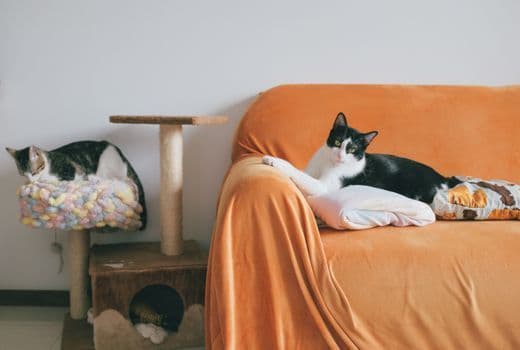
Scent and space should come before face-to-face meetings. Photo by David Yu on Pexels.
Multiple cats need multiple resources: litter boxes, food stations, water, scratchers, resting spots, and escape routes. Resources lined up in one room may still function like one resource if a cat guards the doorway.
Spread things out. Give each cat a way to avoid the other without losing access to essentials.
For litter boxes, many feline behavior resources use the “number of cats plus one” guideline as a starting point. Two cats often need three boxes in different areas, not three boxes lined up beside each other. Food stations, water bowls, scratchers, and resting spots also need separation so one cat cannot control everything by sitting in a doorway.
Short scenario: a quiet cat is not always relaxed
A quiet cat may be frozen, not relaxed. Watch posture. A relaxed cat moves, eats, grooms, and leaves. A tense cat stares, crouches, blocks, or stays hidden.
Do not rush because there has been no fight. The goal is comfort, not merely absence of conflict.
When to get help
Get help if there are repeated fights, injuries, stalking, litter box problems, refusal to eat, or one cat cannot move through the home safely. A veterinarian can also check whether pain or illness is making tolerance lower.
House soiling deserves special care. A cat urinating outside the box during an introduction may be stressed, blocked from the litter route, or dealing with a medical issue such as urinary tract inflammation. Do not assume it is spite. Clean the area, add safe litter access, and ask a veterinarian if the pattern continues or the cat shows discomfort.
Feeding near the door without pressure
Closed-door feeding is useful only if both cats can eat. Start far enough from the door that each cat stays comfortable. Move bowls closer gradually. If one cat stops eating, you moved too fast.
Do not let the cats stare under the door for long periods. Use a draft stopper or towel if door gaps create too much tension at first.
Food is not magic. It only helps if the cats feel safe enough to eat. If one cat is too tense, move the bowl farther away and make the meal easier. If the resident cat guards the hallway after eating, pick up bowls and redirect the cat to another room before opening doors.
Use ordinary meals rather than only high-value treats. If you use special food every time the other cat is nearby, some cats become more excited and pushy. The goal is calm association, not a food contest at the doorway.
Try this sequence:
- Feed both cats with the door closed and bowls far from the door.
- Move bowls slightly closer only when both cats finish normally.
- Add a covered gate or cracked-door view for one or two minutes.
- End the session before staring or swatting begins.
- Return to closed-door feeding if either cat refuses food.
After the first successful meeting
One calm meeting does not mean the introduction is finished. Keep early meetings short. End on a quiet note. Separate before meals, bedtime, or when people leave if you cannot supervise safely.

Gradually increase time together only when both cats can move, eat, and disengage without being chased or blocked.
The first successful meeting should not lead immediately to full access. Keep the base camp available. Let the new cat retreat there and let the resident cat keep familiar resting places. Early shared time works best when the home still has zones.
Watch doorways, hallways, litter boxes, and the path to food. Cats may look peaceful in an open room but create pressure at narrow points. Add extra routes or temporarily block access to places where one cat can corner another.
Do not move forward just because there has been no fight. Move forward when both cats can disengage. A cat who silently stalks, blocks the hallway, or waits outside the litter box is not relaxed simply because nobody hissed.
Common mistake: removing the base camp too early
One good evening does not mean the base camp should disappear the next morning. Keep it available while shared time increases. The new cat may still need a private place to sleep, eat, and use the litter box without being watched.
Removing the base camp too soon can restart tension because the new cat loses the one part of the home that already feels predictable. Phase it out only after both cats can move through the home without blocking, chasing, or guarding important resources.
Borrow the dog-introduction rule, then slow it down for cats
Good introduction advice starts with neutral space, body language, and low pressure. Cats need the same respect for choice, but the setup usually moves slower because territory and scent matter so much. A closed door, scent swap, baby gate, and short visual session are the cat version of keeping pressure low.
The biggest mistake is treating silence as success. A cat who is hiding, blocking a hallway, staring without blinking, or refusing food is not ready just because there has been no fight. Move forward when both cats can eat, rest, groom, and leave the area without being chased.
Source Notes and Further Reading
- Cornell Feline Health Center: Choosing and caring for your new cat
- American Association of Feline Practitioners: Cat friendly homes
- International Cat Care: Introducing cats


