
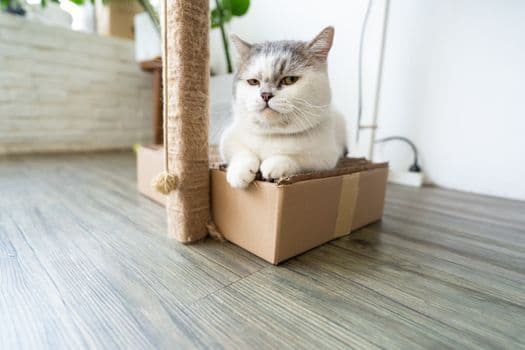
Look at sleep, enrichment, visitors, sounds and rewards before labeling a pet as stubborn.
- Track triggers before correcting
- Reward the behavior you want repeated
- Use qualified help for fear or aggression
Safety note: This article provides general pet behavior education only. It is not a veterinary diagnosis or a substitute for a qualified behavior professional. Contact a veterinarian or certified behavior professional if behavior changes suddenly, includes aggression, self-injury, panic, house-soiling with pain, or signs of illness.
By Best Pet Care Guide Editorial Team
A sunny window can look like the workable enrichment station for an indoor cat. There are birds, leaves, passing people, and warm light. Many cats enjoy watching the world from a perch. The problem starts when the window becomes less like television and more like a daily territorial alarm.
An outdoor cat crossing the garden, a neighbor’s dog, construction, or reflections at night can make a cat tense. The family may only see the aftermath: scratching furniture, urine near the wall, chasing another pet, loud vocalizing, or hiding under the bed.
If you are checking the whole setup rather than one habit, keep why an indoor cat may start scratching the sofa and what to change first and introducing a new cat without rushing the first week open as companion notes.
The window is not always the problem
Some cats can watch birds for hours and settle afterward. Others become wound up and carry that tension into the rest of the home. The difference is not whether the cat is “good” or “dramatic.” It may be the type of view, the cat’s confidence, the number of cats in the home, or whether the cat has a safe way to leave the area.
Watch what happens after the viewing session. A relaxed cat may stretch, groom, nap, or walk away. A stressed cat may lash the tail, flatten ears, pace, swat another pet, scratch near the window, or run to the litter box.
The same window can also change meaning during the day. Morning birds may be interesting. Afternoon construction may be irritating. Night reflections may be startling. A cat who seems to “love the window” may actually love only part of the window routine. Separating those details keeps you from removing a useful enrichment point when only one trigger needs management.
Think about the room around the window too. A narrow sill behind a sofa may force the cat to jump down into another pet’s path. A perch beside a loud appliance may keep the cat tense. A window next to a litter box can make elimination feel less private if outdoor cats appear there. The view is only one part of the setup.
Observation log: three days at the window
For three days, note:
- time of day
- what the cat saw outside
- whether the body became stiff or low
- whether the tail flicked or thumped
- what happened in the next ten minutes
- whether another pet was nearby
- whether the cat could leave without being blocked
Patterns often appear quickly. A cat may be fine with birds but not outdoor cats. Another may enjoy daytime views and become unsettled by night reflections.
Common triggers and first adjustments
Do not remove every view without knowing the pattern. For many cats, the right view is helpful. The goal is to reduce the view that repeatedly causes stress.
Give the cat an exit route
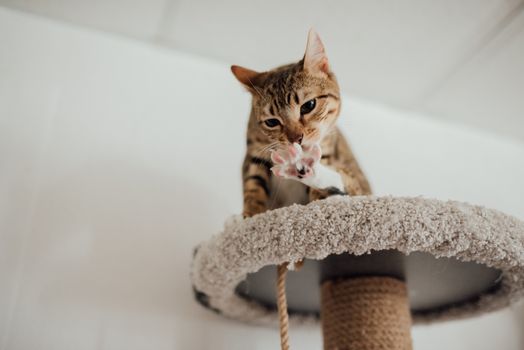
Scratching near windows can be one clue that a view has become too intense. Photo by Arina Krasnikova on Pexels.
A window perch should not trap the cat. If the perch is wedged behind furniture or watched by another pet, the cat may feel cornered. Make sure the cat can step down and leave without passing through a narrow conflict point.
In multi-cat homes, one prime window can become a contested resource. Add another perch in a different room or at a different height. Separate resources reduce the need for cats to negotiate every good spot.
An exit route should be obvious to the cat, not just technically available. If a dog sleeps between the perch and the doorway, the cat may not feel free to leave. If a child often approaches the perch for cuddles, the cat may stay stiff instead of stepping down. Place a chair, shelf, or low table so the cat has more than one way out.
For older cats, jumping down from a high perch can be the stressful part. Add a step or lower platform. A cat who hesitates before leaving may not be stubborn; the landing may feel uncomfortable.
What to do when outdoor cats are the issue
If outdoor cats approach windows or doors, reduce direct sight lines for a while. Frosted film on the lower part of a window, curtains at certain hours, or moving a perch higher can help. Avoid punishment when your indoor cat reacts. The cat did not invite the trigger and may already feel threatened.
Clean any urine marking with an enzymatic cleaner. If urination continues, talk with a veterinarian. Urinary problems and stress can overlap, and guessing can delay care.
If the same outdoor cat visits repeatedly, note the time and route. Some cats pass through at dawn, others sit near glass doors in the evening. You may be able to block the specific view only during the problem window. That is better than making the whole house visually blank all day.
Avoid putting food outside near the window if it attracts neighborhood cats. If bird feeders are part of the yard, place them far enough away that the indoor cat can watch without feeling like prey or rivals are pressed against the glass.
Add a finishing activity
Some cats need help coming down from high alert. A short play session away from the window can redirect energy into a clear beginning and ending. Move a wand toy like prey, let the cat catch it, then offer a small meal or treat if appropriate.
This does not reward stress. It gives the cat a normal predatory sequence that ends in a calmer state.
What not to do
Avoid these common mistakes:
- tapping the glass to excite the cat
- placing bird feeders so close that the cat spends hours frustrated against the window
- allowing one cat to guard the only sunny spot
- assuming a cat who stares quietly is relaxed
- punishing swatting, marking, or vocalizing instead of reducing the trigger
How to tell enrichment from frustration
A useful window perch leaves the cat with more calm options afterward. The cat watches, blinks, shifts position, maybe chirps, and then eventually leaves. A frustrating window creates a loop: stare, tense, slap the glass, run to another pet, return, repeat. The activity looks engaging, but the cat is not settling.
Look at the whole day. If window time is followed by litter box problems, furniture scratching, or conflict with another pet, the view may need adjustment. If the cat naps afterward and uses the window at normal times, it may be a good enrichment point.
Chattering alone is not automatically a problem. Some cats chatter at birds and then settle normally. The concern grows when the cat cannot disengage, when body tension stays high, or when the reaction spills into other behaviors. A cat who watches, chirps, and later naps is different from a cat who watches, crouches, growls, and attacks the nearest household cat.
Duration matters too. A few minutes of focused watching can be normal. Hours of repeated scanning may mean the cat is stuck in an alert state. If the cat keeps returning to the window after every interruption, add a clearer ending to the activity with play, food, or closing that view for a while.
Adjust without removing all interest
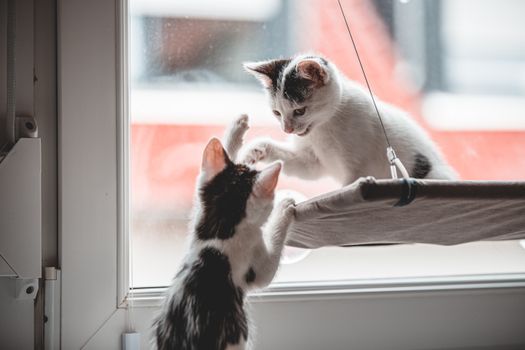
Owners sometimes solve the problem by closing every curtain. That may reduce one trigger but also remove a daily source of stimulation. Try partial changes first. Cover only the lower half of the window where outdoor cats appear. Move a perch to a side window. Close curtains at dusk but open them in the morning. Add a second perch so one window does not become the only important resource.
If birds are the trigger, consider moving feeders farther from the glass. The cat can still watch, but the activity may feel less like unreachable prey pressed against the window.
Multi-cat homes need more escape routes
Window stress often spreads sideways. One cat sees an outdoor cat and cannot reach it, then swats the nearest indoor cat. This is called redirected aggression, and it can create confusion because the second cat did nothing wrong.
When that happens, do not force the cats back together immediately. Create space, reduce the outside trigger, and let both cats settle. If redirected aggression repeats, the home needs a more careful management plan.
After a tense window event, separate calmly before the next interaction becomes a second problem. Close a door, offer each cat a quiet space, and wait until both bodies soften. Do not pick up a highly aroused cat unless you must for safety; a cat in that state may scratch without intending a normal social response.
If one cat regularly guards the sunny perch, add an equally good option elsewhere. A second perch that is lower, colder, or hidden behind clutter may not count. In cat terms, equal means the resource has similar comfort, safety, and access.
Decision tree: keep, move, or block the view
If the cat watches briefly and then naps, keep the perch and leave the routine alone. If the cat watches for long periods but stays loose, add play after viewing and make sure food, litter, and resting spaces are not all near that window.
If the cat becomes stiff, lashes the tail, growls, redirects onto another pet, or urinates near the window, reduce the trigger. Start with the smallest useful change: close curtains at the problem hour, block the lower half of the glass, move a bird feeder farther away, or shift the perch to a side window.
If the same outdoor cat appears daily, treat that as a predictable stressor. Motion sprinklers, privacy film, or closing access to that specific view during peak hours may help. Do not punish the indoor cat for reacting to something outside the home.
Small setup changes first
You do not need an expensive cat wall to test whether the window is the issue. Cardboard scratchers, a stable chair near a calmer window, removable privacy film, and a folded blanket on a sturdy shelf can all change the experience.
Spend money only after you know the pattern. If the problem is an outdoor cat at ground level, a taller perch may help more than another toy. If the problem is boredom, play and food puzzles may matter more than curtains.
When behavior needs professional help
Ask a veterinarian or qualified behavior professional for help if the behavior appears suddenly, includes biting or repeated aggression, causes injury, involves panic, happens with pain or appetite changes, or gets worse despite calmer handling. Training works better after pain, fear, and medical causes are considered.
Window watching is not always enrichment
Some cats relax while watching birds, people, and outdoor cats. Others become tense, vocal, restless, or aggressive after repeated window exposure. The difference is recovery. A cat who watches, turns away, grooms, eats, and sleeps is coping. A cat who crouches, lashes the tail, redirects aggression, or patrols the window for hours may be stressed.
Do not judge by cuteness. Judge by what the cat does after the trigger leaves.
A window stress decision tree
If the cat watches calmly, keep the perch and make the area comfortable. If the cat becomes tense only when outdoor cats appear, block the lower sightline during those times and remove food from the window area. If the cat redirects aggression toward people or pets, close access and ask a behavior professional for help. If stress appears suddenly, check for pain or illness with a veterinarian.
The best window setup gives the cat choice. A cat who cannot leave the view may feel trapped by the stimulus.
Alternatives that still feel like cat enrichment
Try a perch facing a quieter view, scent games, short play sessions, food puzzles, cardboard exploration, or a predictable bird video used briefly rather than all day. Rotate options. Enrichment should help the cat recover, not keep the nervous system switched on.
Related reading for the same problem
For related cat-care routines, compare what to check when a cat stops using the litter box, new cat introductions without rushing, and indoor cat scratching changes before blaming the sofa.
Stress levels to watch at windows, doors, and balconies
The same pattern can happen at glass doors, balcony railings, porch windows, and fenced yards where outdoor cats pass close to the home.
Single-cat and multi-cat home differences
In a single-cat home, the main question is whether the cat can leave the view and recover. In a multi-cat home, one cat’s window stress can spill into another cat through chasing, blocking, or redirected swats. If tension rises after outdoor-cat sightings, add separate resting zones and avoid feeding cats near the trigger window.
Do not punish the cat for reacting. The reaction is information about stress level. The useful change is distance, blocking the view, more resources, and a calmer recovery route.
When window stress becomes a health or welfare issue
Call a veterinarian if stress appears with refusal to eat, sudden litter-box changes, blood in urine, repeated vomiting, skin damage from grooming, or hiding that is not normal for the cat. Ask a qualified behavior professional for repeated redirected aggression or fights between household cats. Visual blocking can help, but it should not replace medical screening when symptoms change suddenly.
Related reading for the same problem
For related cat-care routines, compare litter-box troubleshooting, new cat introductions, and sofa scratching changes.
Read the whole window routine
Watch the animal before choosing a fix. For cats, that means watching the whole window routine: tail flicks, crouching, redirected swats, spraying, blocked paths, and whether the cat can leave the window and settle.
A cat who chatters at birds for a minute and then naps is different from a cat who patrols the same glass for an hour after seeing an outdoor cat. Change the setup for the second cat first: reduce the trigger view, add a better resting spot, and protect food, litter, and scratchers from being trapped near the stressful window.
Source notes and further reading
- ASPCA: Common dog behavior issues
- ASPCA: Common cat behavior issues
- International Association of Animal Behavior Consultants: Find a behavior consultant
- Cornell Feline Health Center: Cat health topics


