Check access, storage and escape paths before assuming a familiar room is safe.
- Secure cords, bins and cleaning supplies
- Check plants and small objects
- Plan exits, gates and travel routines
Safety note: This article provides general household pet safety guidance only. It is not veterinary medical advice, diagnosis, poison-control instruction, or emergency treatment guidance. If a pet swallows a toxic item, foreign object, medication, chemical, battery, string, or sharp object, contact a veterinarian or animal poison control right away.
By Best Pet Care Guide Editorial Team
Pet toys are marketed as fun, cute, tough, natural, interactive, calming, dental, or boredom-busting. That variety can make shopping feel simple: choose the toy that looks right. But a safe toy for one pet may be risky for another.
A gentle senior dog, a puppy with sharp teeth, a cat who chews string, and a powerful adult chewer do not need the same items. Safety depends less on the label and more on the animal using it.
If you are checking the whole setup rather than one habit, keep how to build a rainy-day enrichment plan for restless pets and a room-by-room pet safety reset for busy homes open as companion notes.
How to choose safer pet toys by chewing style
Size matters. A toy that can slide fully into the mouth may become a choking risk. A chew that is too hard may damage teeth. A soft toy with loose parts may be shredded and swallowed.
Watch the first few sessions. Do not assume a toy is safe because it survived five minutes in the store aisle.
The first test should happen when you can watch without distractions. Put the toy down, let the pet investigate, and notice the style of play. Does the dog lick, carry, gnaw, shred, or try to swallow pieces? Does the cat bat the toy, chew the string, or drag it under furniture? The answer tells you more than the packaging does.
Age changes the answer too. A puppy who was gentle last month may become a determined chewer during teething. A senior dog may need softer textures. A cat who ignores toys may suddenly chew ribbon when bored. Toy safety is not a one-time decision; it is a quick review every time the pet’s habits change.
A quick buying check
Add one more household question: who will put this away? Some toys are safe during interactive play but risky when left out. If the family cannot reliably put away string toys, small parts, or food-filled items, choose simpler options for everyday access.
For online purchases, read negative reviews as well as positive ones. Look for patterns: seams opening quickly, strong odor, pieces breaking off, sizing smaller than expected, or pets swallowing parts. One dramatic review may not mean much, but repeated reports can help you avoid a poor match.
Cats and string need special caution
Many cats love string, ribbon, yarn, and wand toys. Those items should be used with supervision and put away afterward. Swallowed string can cause serious internal problems.
Wand toys are excellent for play because they let the toy move like prey. They are not good items to leave on the floor all day if the cat chews cord or ribbon.
After play, store string toys behind a closed door or in a container the cat cannot open. Do not wrap the cord around a chair leg and assume it is handled. A bored cat can work at knots, tassels, and elastic. If a cat swallows string, do not pull visible string from the mouth or rear end; contact a veterinarian.
For cats who love chewing, try safer alternatives such as sturdy solo toys, food puzzles designed for cats, or supervised chew items recommended by a veterinarian. Keep the wand toy for sessions where a person controls the movement and the ending.
Dogs who chew hard
Power chewers need careful choices. Very hard bones, antlers, or objects can crack teeth. Soft toys may be destroyed quickly. Some rubber toys, food puzzles, or veterinarian-recommended chews may be better fits, but supervision still matters.
If a dog guards chews, solve the management problem before adding high-value items. Give space. Avoid taking items away repeatedly as a test. Ask for qualified help if guarding is intense.
The “too hard” problem is easy to underestimate. People often think natural means safe, but some natural items are extremely hard. Veterinary dental groups commonly warn owners to be cautious with objects that are harder than the teeth, especially for aggressive chewers. Ask your veterinarian what is appropriate for your dog’s mouth, age, and chewing force.
Watch the chewing angle. Some dogs grind a chew with the back teeth. Others try to crack it. Some soften an item slowly. A chew that is fine for a careful dog may be a dental risk for a dog who bites down with full force.
Short example: the toy was safe until the puppy changed
A soft rubber toy may be fine for a gentle puppy at four months. Two months later, the same puppy may have stronger jaws, more adult teeth coming in, and a new habit of peeling the edges. The toy did not become “bad”; the match changed.
That is why the first-week review matters. If the toy starts showing tooth marks, missing corners, or sticky cracked edges, move it from everyday use to supervised use or throw it away. Pet safety is often a timing issue, not a single purchase decision.

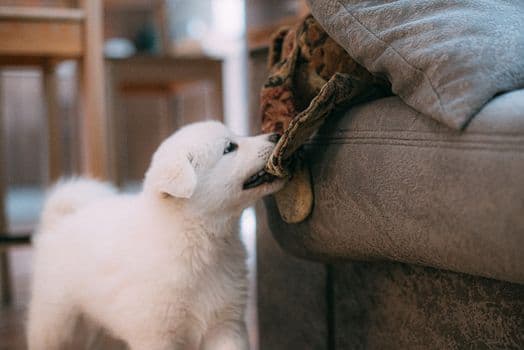
Watch how a pet uses a toy before leaving it out. Photo by Evgenia Basyrova on Pexels.
When to throw a toy away
Throw away toys with sharp edges, loose stuffing, exposed squeakers, cracked rubber, frayed strings, missing pieces, or a size that has become small enough to swallow. This is not wasteful; it is prevention.
Set a weekly toy check. It takes less than five minutes and prevents old toys from becoming hazards.
Common mistake: using toys as the whole enrichment plan
Toys help, but pets also need interaction, rest, routine, scent, movement, and choices. A basket of toys on the floor can become background clutter. Rotate a few items instead.
For dogs, short training games and sniffing walks may reduce destructive chewing better than buying another toy. For cats, a play sequence that ends with a catch can be more satisfying than leaving ten toys out.
Supervision levels are different
Some toys are fine only when a person is watching. Others can stay out longer. A stuffed toy with a squeaker may be safe for a gentle dog and unsafe for a shredder. A wand toy may be workable interactive play for a cat and unsafe if left out with string attached.
Label toys in your own mind: supervised, short-session, or everyday. That simple system prevents the toy basket from becoming a hazard pile.
For example, a flirt pole may be supervised only. A food-stuffed rubber toy, including popular styles such as Kong-type toys, may be short-session because it needs cleaning afterward. A durable ball that is too large to swallow and has no damage may be everyday for one dog, but not for a dog who peels rubber apart. The category belongs to the pet, not the toy.
For hard chewers, some owners compare nylon chews, rubber toys, dental chews, and food puzzles. Brand familiarity is not enough. A Nylabone-style chew, a Kong-style rubber toy, or any dental chew still has to match the individual pet’s size, chewing force, dental history, and supervision level.
Write the category on a storage bin if several people care for the pet. This is useful in homes with children, roommates, or pet sitters. “Blue bin stays out, red bin needs an adult” is easier than explaining every toy again.
Food toys need cleaning and portion awareness
Food puzzles and stuffed toys can help with boredom, but they add calories and need cleaning. Count the food inside as part of the day’s intake. Wash items that hold wet food. Throw away cracked items that can trap residue or break into pieces.
For pets with allergies, pancreatitis history, weight plans, or medical diets, ask before adding rich fillings.
Start easy. A puzzle that is too difficult can create frustration rather than enrichment. For dogs, begin with loose kibble in a simple toy before packing food tightly. For cats, begin with a few pieces that fall out easily. The pet should learn that working with the toy pays off, not that the toy is impossible.
Clean on a schedule. A toy that held wet food yesterday should not sit under the sofa until next week. If the toy has grooves you cannot clean, use it only with dry food or choose a different design.
Safer toy rotation
Instead of leaving everything out, rotate a few toys every few days. Keep high-excitement items for short sessions. Put damaged toys in a discard spot immediately rather than telling yourself you will check later.

A small, safe rotation is better than a huge basket of half-broken options.
Rotation also keeps novelty without constant buying. Put away half the safe toys for a week, then swap. Keep one or two favorites available if the pet relies on them for comfort. Remove damaged items immediately rather than waiting for the next rotation.
If a pet becomes possessive over one item, do not make that item part of casual shared play. Use it only in a managed space or remove it from the routine while you ask for guidance. A toy that creates tension is not enriching the household.
The toy shelf test
Once a month, empty the toy shelf or basket and sort everything into four groups: safe to keep out, supervised only, needs cleaning, and throw away. This takes a few minutes and turns safety into a routine instead of an emergency reaction.
If most toys end up in the throw-away group, buy fewer toys more carefully. If most are supervised only, create a separate place so they do not get left out by accident. If most need cleaning, choose designs that are easier to wash. The shelf tells you what the real household pattern is.
Young pet toy rules
Teething puppies may need softer, size-safe options and frequent inspection because chewing strength changes quickly. During early teething, choose flexible toys that can be indented by a thumbnail and are too large to swallow. As adult teeth come in, avoid jumping straight to rock-hard chews; overly rigid items can damage teeth. Heavy chewers need durability, but durability should not mean stone-like hardness.
Kittens need strict supervision with string, ribbon, yarn, hair ties, feathers, bells, plastic eyes, and small parts. Put wand toys away after play. Linear objects can become serious ingestion hazards if swallowed, so string toys should not be left out for independent play.
Senior pets may need softer textures and easier grip. Cats need interactive play that ends with a catchable object or treat, not endless frustration.
What toy reviews can and cannot tell you
Toy reviews are most useful when they look at material, durability, cleaning, and which dogs the toy suits. A review cannot tell you how your own pet will chew. Two dogs can use the same toy in completely different ways: one carries it around, another removes the corner in ten minutes.
Treat the first week as a test period. Watch for cracked rubber, loose fibers, exposed squeakers, swallowed pieces, guarding, or obsessive chewing. Keep interactive toys and string toys put away after use. If a chew is harder than the teeth or small enough to swallow, it is not safer just because the label sounds natural.
Source Notes and Further Reading
- FDA: Potentially dangerous items for your pet
- AVMA: Household hazards
- ASPCA Animal Poison Control Center: Animal poison-control guidance


