Start with the smallest routine that the pet and household can handle consistently.
- Keep sessions short and predictable
- Watch comfort and stress signals
- Escalate grooming or health concerns to a pro
Safety note: This article provides general pet behavior education only. It is not a veterinary diagnosis or a substitute for a qualified behavior professional. Contact a veterinarian or certified behavior professional if behavior changes suddenly, includes aggression, self-injury, panic, house-soiling with pain, or signs of illness.
Many dogs are quiet for most of the day and then become very busy exactly when people want the house to slow down. The pattern can look like barking at window reflections, stealing socks, pawing at the sofa, chasing another pet, or standing by the back door every ten minutes. It is easy to label the dog as stubborn. More often, the evening has loose edges: food arrived, people changed rooms, outdoor sounds shifted, and nobody has given the dog a clear next job.
This guide is informational only and cannot diagnose a pet. Sudden behavior changes, pain signs, repeated vomiting, collapse, breathing trouble, urinary difficulty, suspected poisoning, or a swollen abdomen need prompt veterinary help. For general pet-owner safety references, see the AVMA pet care resources at https://www.avma.org/resources-tools/pet-owners/petcare and the FDA household hazard list at https://www.fda.gov/animal-veterinary/animal-health-literacy/potentially-dangerous-items-your-pet.
For a connected next step, read a calmer home plan for dogs afraid of storms or fireworks and preparing a dog for car rides without making every trip stressful. They give more detail on the household routines that usually sit beside this decision.
Start with the first twenty minutes after dinner
For many households, the mistake is asking for stillness too soon. A dog eats, watches plates move, hears chairs scrape, and then gets told to lie down while people clean up. That is a hard switch. Instead, plan a short bridge between dinner and rest. The bridge should be boring enough not to wind the dog up, but active enough to satisfy the need to do something.
Good bridge activities include a slow sniff walk, a scatter of regular kibble in a snuffle mat, a few calm hand-target repetitions, or a chew that your dog can handle safely. Avoid hard exercise right after a large meal, especially for deep-chested breeds or dogs with a history of digestive problems. If you have concerns about bloat risk, ask your veterinarian what timing is sensible for your dog.
A simple evening sequence
Try the same sequence for one week before deciding it failed. Dogs read repetition better than speeches.
- Clear dinner bowls and take the dog outside for a short, unhurried bathroom break. Let sniffing happen. Do not turn it into a march.
- Return to one calm room. Lower the amount of household traffic if you can.
- Offer one approved settling activity: lick mat, soft chew, food puzzle, or a towel with a few pieces of kibble folded inside.
- When the activity ends, guide the dog to a mat, bed, crate, or gated area where resting is normal.
- Reward quiet moments before the dog escalates. A small piece of food placed calmly between the paws is often better than excited praise.
The point is not to exhaust the dog. The point is to remove the guessing. A dog who knows what usually happens after dinner spends less energy inventing options.
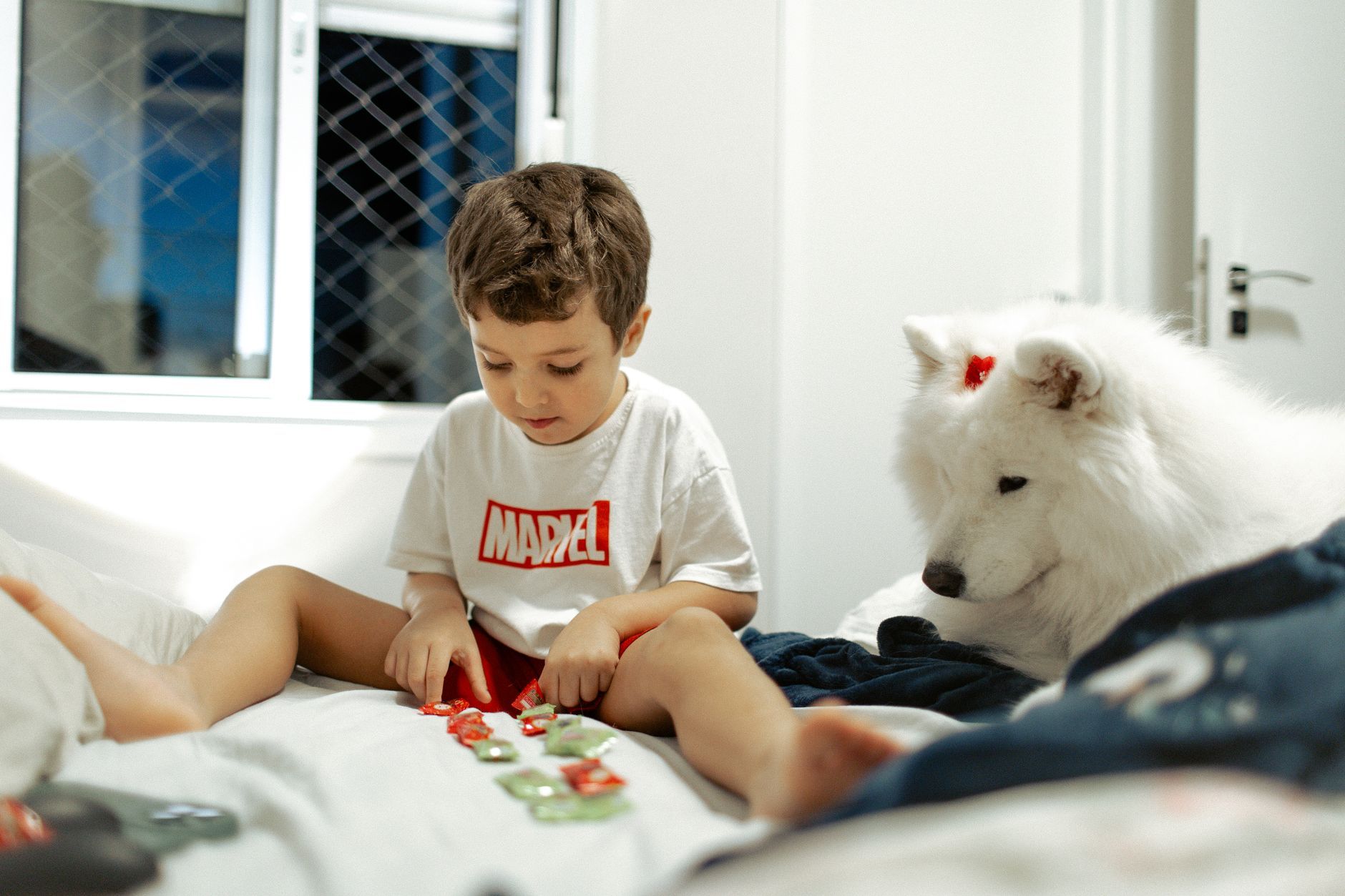
A young boy plays with puzzles on a bed while a Samoyed dog watches, inside a cozy room. Photo by Helena Lopes on Pexels.
Use an observation note, not a debate
For seven evenings, write down the time dinner ended, the first restless behavior, what helped, and what made it worse. Keep it plain. “Barked at hallway at 7:40 after delivery truck” is useful. “Acted terrible all night” is not. If more than one person handles the dog, use the same note so everyone sees the pattern.
Patterns often appear quickly. Some dogs get restless when they are overtired. Some need a bathroom trip twenty minutes after eating. Some react to neighborhood sounds at dusk. Some are fine until the family starts a loud show. Once you know the trigger, the plan becomes less emotional.
Common mistake: rewarding the loudest request
If the dog barks and someone immediately opens the door, starts a game, or hands over a chew, barking can become the evening request button. That does not mean you should ignore distress or bathroom needs. It means the routine should deliver useful outlets before the dog has to shout for them.
Build the outlet into the schedule. If the dog normally starts pawing at 8:00, offer the calm activity at 7:45. If the dog needs a final bathroom trip, make it predictable and dull. The more dramatic the response, the more important the behavior can become to the dog.
Match the reset to the dog in front of you
Young dogs may need more chewing and very short training games. Senior dogs may need pain-aware comfort, better bedding, a slower walk, or a night light. Dogs with noise sensitivity may settle better away from windows. Dogs in multi-pet homes may need separation during chews so nobody guards resources.
The ASPCA has a useful overview of enrichment ideas and the need to match activities to the animal rather than copying a trend: https://www.aspca.org/pet-care/dog-care/general-dog-care. Use that idea here. A puzzle feeder that calms one dog may frustrate another. A chew that is safe for one dog may be too hard, too small, or too rich for another.
When the evening reset is not enough
Call a veterinarian if restlessness is new, intense, or paired with panting, pacing, vomiting, repeated attempts to urinate, limping, belly swelling, disorientation, sudden house soiling, or a change in appetite. These are not training puzzles. They may need medical attention.
For long-running fear, reactivity, separation distress, or conflict between pets, look for a qualified behavior professional who uses humane, evidence-informed methods. Avoid advice that depends on frightening the dog into silence. A quiet dog is not always a relaxed dog.
A practical one-week test
Pick one room, one bridge activity, one rest spot, and one note format. Keep the setup dull and repeatable. After a week, ask three questions: Did the first restless behavior happen later? Did the dog recover faster? Did people argue less about what to do? If the answer to any of those is yes, the routine is doing work.
Evening calm is rarely one magic command. It is usually a small reset that arrives before the dog has to make bad choices. Feed, sniff, settle, observe, adjust. That is enough structure for many homes.
If more than one dog is involved
Two dogs can make the evening feel louder than either dog would alone. One dog starts watching the window, the other joins because movement feels important. One gets a chew, the other stares, and the room tightens. In multi-dog homes, run the reset with space between dogs at first. Separate mats, separate chews, and separate exits reduce guarding and copying.
Do not ask the calmer dog to absorb the restless dog’s energy. That is a common household mistake. Each dog needs a clear place and a clear activity. If one dog finishes early, remove that dog’s empty chew or puzzle so it does not become something to defend. If tension appears around food or resting places, stop the shared-room plan and get qualified help.
Apartment and terrace-home adjustments
Not every dog has a garden, and not every home can offer a long evening walk. For apartments, the bridge activity may be a slow hallway exit, a sniffing loop around the block, or a few minutes on a quiet patch of pavement. For terrace homes or flats with shared stairs, keep the return calm. The dog should not learn that every evening reset ends with racing up steps or barking at neighbors.
Noise is also different in dense housing. Lifts, bins, delivery doors, and hallway voices can all become evening triggers. If the dog watches the door, move the resting spot so the dog is not staring directly at the sound source. White noise or a fan may help some homes, but it should not be used to cover signs of distress.
What progress looks like
Progress is not a dog who never asks for anything. Progress may be a dog who barks twice instead of ten times, settles after a chew instead of pacing for an hour, or accepts a mat cue with less negotiation. Keep the goal modest enough that people can repeat it tomorrow.
If the plan works only when one unusually patient person handles everything, it is too fragile. A good evening routine should be simple enough that a tired adult, a responsible teenager, or a pet sitter can follow the main steps without a lecture.
If more than one dog is involved
Two dogs can make the evening feel louder than either dog would alone. One dog starts watching the window, the other joins because movement feels important. One gets a chew, the other stares, and the room tightens. In multi-dog homes, run the reset with space between dogs at first. Separate mats, separate chews, and separate exits reduce guarding and copying.
Do not ask the calmer dog to absorb the restless dog’s energy. That is a common household mistake. Each dog needs a clear place and a clear activity. If one dog finishes early, remove that dog’s empty chew or puzzle so it does not become something to defend. If tension appears around food or resting places, stop the shared-room plan and get qualified help.
What progress looks like
Progress is not a dog who never asks for anything. Progress may be a dog who barks twice instead of ten times, settles after a chew instead of pacing for an hour, or accepts a mat cue with less negotiation. Keep the goal modest enough that people can repeat it tomorrow.
If the plan works only when one unusually patient person handles everything, it is too fragile. A good evening routine should be simple enough that a tired adult, a responsible teenager, or a pet sitter can follow the main steps without a lecture.
When behavior needs professional help
Ask a veterinarian or qualified behavior professional for help if the behavior appears suddenly, includes biting or repeated aggression, causes injury, involves panic, happens with pain or appetite changes, or gets worse despite calmer handling. Training works better after pain, fear, and medical causes are considered.
Why the hour after dinner can go sideways
Many dogs get busier after dinner because the house changes all at once. People sit down, dishes smell interesting, children move through the room, screens turn on, and the dog may have energy left from a quiet day. Owners often read this as misbehavior. It is usually a routine problem.
A calmer evening starts before the dog is already pacing. Give the dog a bathroom break, clear food scraps, choose one quiet activity, and reduce window triggers. If the dog has a predictable place to settle, the evening asks less decision-making from everyone.
A reset plan for three different dogs
A young dog may need a short sniff walk, then a chew or food puzzle in a defined space. A senior dog may need a bathroom break, a non-slip path, water nearby, and a bed away from traffic. A sound-sensitive dog may need curtains closed and a quieter room before neighborhood noise starts.
Use the dog in front of you, not a generic evening routine. The plan should lower arousal without exhausting the dog or turning every night into a training project.
When evening restlessness is not a routine issue
Call a veterinarian or qualified behavior professional if evening restlessness appears suddenly, includes pain signs, confusion, panting at rest, repeated vomiting, house-soiling, aggression, panic, or inability to sleep. A calm routine helps ordinary overstimulation. It should not mask illness, pain, cognitive changes, or anxiety that needs professional help.
Related reading for the same problem
For related dog routines, compare helping a dog stay calm when left alone, the storm and fireworks plan, and dog car ride preparation without stress.
Age and species adjustments for the evening reset
Young dogs often need a short bathroom trip, two or three minutes of sniffing, and a boring transition into rest. Adult dogs may settle with a predictable post-dinner cue: water check, quiet mat, one chew or puzzle, and curtains closed if outdoor movement starts barking. Senior dogs need a slower version with non-slip footing and no fast chase games after a meal.
Cats can also become active after eating, but the plan is different. Use a short wand session before the meal, not a wild chase afterward. After eating, give a quiet perch, clean water, and a predictable litter-box path. If a cat starts pacing, yowling, hiding, or acting tense after meals, treat it as a pattern to observe rather than a normal zoomie by default.
Health boundary before calling it restlessness
Repeated post-meal agitation can have a medical cause. Watch for drooling, repeated lip licking, retching, vomiting, a hunched belly, restlessness that does not settle, panting at rest, sudden aggression, or refusal to lie down. Those signs are reasons to call a veterinarian, especially in deep-chested dogs where post-meal distress can become urgent.
Do not use hard exercise to tire a dog out right after dinner. Keep the reset low-impact, quiet, and short. If a pet seems uncomfortable after several meals in a row, change the question from “How do I calm this pet?” to “Could food, pain, nausea, or another health issue be involved?”
Printable five-step evening reset
- Clear food scraps and close the trash.
- Give the pet a calm bathroom or litter-box opportunity.
- Choose one quiet activity: sniffing, mat rest, gentle chewing, or a small puzzle.
- Reduce triggers such as windows, door noise, and children running through the room.
- Write down repeated signs that look physical, not behavioral.
Keep this checklist near the food area. The point is consistency, not a workable nightly training session.
Related reading for the same problem
For related behavior and routine topics, compare alone-time calm, storm and fireworks planning, and car ride preparation.
Source notes and further reading
- ASPCA: Common dog behavior issues
- ASPCA: Common cat behavior issues
- International Association of Animal Behavior Consultants: Find a behavior consultant
- Cornell Feline Health Center: Cat health topics


