Use life stage, body condition and veterinary guidance before trusting package claims.
- Match food to life stage
- Measure treats and extras
- Ask a veterinarian about medical diets
Safety note: This article provides general pet nutrition education only. It is not veterinary medical advice, diagnosis, treatment, or a diet prescription. Contact a veterinarian before changing food for puppies, seniors, pregnant pets, pets with chronic disease, or pets with vomiting, diarrhea, weight loss, refusal to eat, or suspected toxin exposure.
By Best Pet Care Guide Editorial Team
Feeding one pet can be simple. Feeding two or more can turn into a daily management problem. One dog finishes first and checks every bowl. A cat steals another cat’s food.
A senior pet eats slowly while a younger animal waits nearby. Someone leaves food out all day because separating meals feels exhausting.
The result may be weight gain, stress, missed medication, vomiting from fast eating, or conflict around the kitchen. A better routine protects each animal’s meal without making the household feel like a boarding facility.
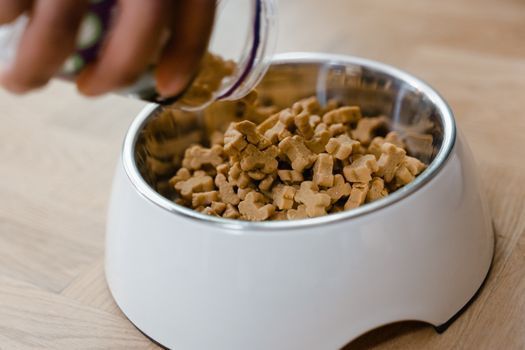
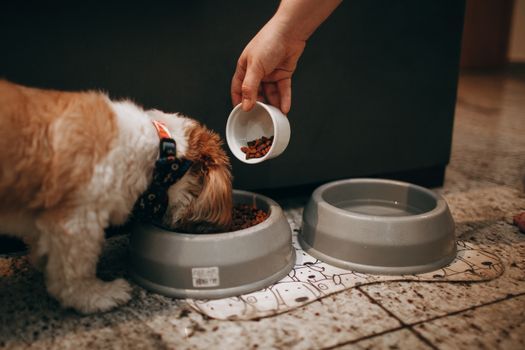
Measured meals make multi-pet feeding easier to manage. Photo by MART PRODUCTION on Pexels.
If this topic is part of a wider home routine, it helps to compare it with how to switch pet food without turning dinner into a stomach problem and indoor cat weight management without crash diets. Those nearby guides cover moments that often overlap with this one.
How to identify your pets’ feeding problem
Different feeding problems need different fixes. Is one pet eating too much? Is one pet not eating enough? Is there growling near bowls? Is a prescription diet being shared? Is a cat grazing while a dog cleans up leftovers?
Do not change everything at once. Identify the main risk first.
It helps to describe the problem without blaming the pet. “Milo steals food” may be true, but “Milo finishes in thirty seconds and then walks to the cat bowl” gives you something to solve. “The cats are picky” may become “one cat eats only when the room is quiet and the other cat is shut out.” Better descriptions lead to better routines.
For one week, watch meals as if you were collecting household data. Who arrives first? Who leaves food? Who looks tense? Which bowl is always empty? Which pet eats faster when another animal enters? These observations matter more than assumptions about personality.
Three common household patterns show up again and again:
This is why the first step is observation, not correction. A pet cannot explain whether the problem is hunger, pressure, pain, habit, or access.
Bowl placement that reduces pressure
Placement can change the emotional tone of a meal. Bowls lined up along one wall may look organized, but they can make pets eat shoulder to shoulder.
A narrow kitchen corner may trap a cautious pet. A hallway may turn every passing animal into a threat. Try feeding stations with visual breaks: one around a corner, one behind a gate, one in a bedroom with the door closed for ten minutes.
For cats, height can help only when the cat is comfortable jumping and landing. A high shelf may protect food from a dog but may be unfair to an older cat with sore joints. For dogs, distance may be more useful than raised bowls. The right placement is the one that lets each pet eat without rushing.
Separate does not mean complicated
Separate feeding can be as simple as closing a door for ten minutes. Use rooms, baby gates, crates if already comfortable, laundry areas, or timed feeders. The goal is not punishment. It is privacy.
For cats, vertical space can help, but only if the cat can access it safely and the dog cannot. For older cats, jumping to a high feeding station may be painful, so a gated room may be kinder.
Watch body language around bowls
Food guarding can be subtle before it becomes dangerous. Watch for:
- stiff posture over the bowl
- hard staring when another pet approaches
- hovering over food after the meal is finished
- eating faster as another animal enters the room
- growling, snapping, or blocking access
- leaving the bowl because another pet is watching
Do not test guarding by taking food away repeatedly. That can make the pet more worried. Instead, manage distance and ask for professional help if guarding is intense or escalating.
Also watch the pet who avoids the conflict. A slow eater may step back every time another animal glances over. A cat may wait until the kitchen is empty and then eat too little. A senior dog may leave because standing on a slick floor is uncomfortable.
The loudest pet is not always the only pet affected.
If children are in the home, meals need an extra rule: no walking between eating pets, no touching bowls, and no offering high-value chews without an adult. Many bites happen around valued resources, and prevention is much kinder than expecting a pet to tolerate crowding.
Portion control without drama
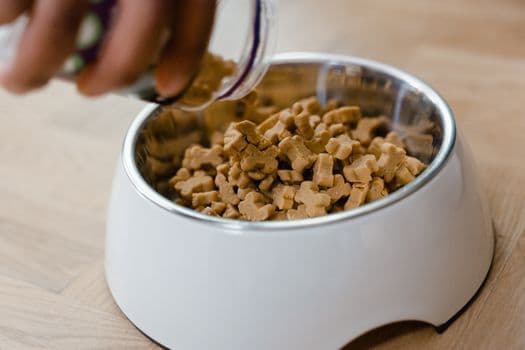
Measure food for each pet. Write the amount down. Include treats. In multi-pet homes,“just a few extras” often disappear into the wrong animal.
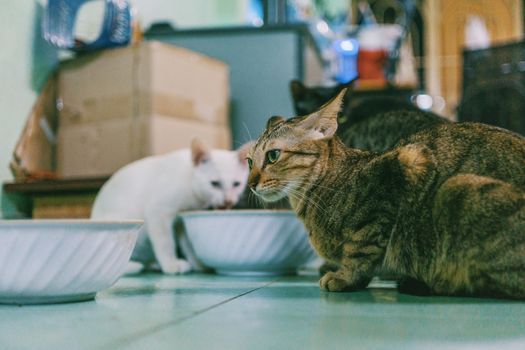
If changing portions for weight management, do it with veterinary guidance. Cats especially should not be crash-dieted.
Why free-choice bowls can hide the real problem
Leaving food out all day, or free feeding, may reduce one kind of conflict and create another. It makes intake hard to track. It lets one pet eat more than intended. It can hide appetite loss in a sick animal.
Free feeding may work in some homes, but it should be a conscious choice, not a default because meals feel chaotic.
A seven-day reset
- Day one: feed pets apart and watch who finishes first.
- Day two: measure portions instead of estimating.
- Day three: remove bowls after meals if appropriate.
- Day four: note who looks for extra food.
- Day five: adjust station placement.
- Day six: check body condition and treat amounts.
- Day seven: keep the simplest setup that protected every pet.
The reset works best when the household treats it as temporary information gathering, not a permanent burden. You may discover that only one door needs to close. You may discover that meals need five more minutes. You may discover that the real problem happens after meals, when bowls are left down and one pet keeps checking them.
At the end of the week, remove only the steps that are clearly unnecessary. If separate rooms stopped stealing and tension, keep them. If one pet never approached another bowl, you may be able to simplify that part. A routine that looks a little structured but keeps everyone calm is usually better than a “natural” setup that creates daily pressure.
Protect the slow eater
The slow eater often loses in a multi-pet home. They may walk away because another animal approaches, or they may eat too fast because they expect competition. Either pattern can affect health. Give the slow eater a protected space with enough time to finish.
This is especially important for senior pets, cats, small dogs, and animals recovering from illness. A pet who eats slowly is not always picky; they may be cautious, painful, or pressured.
Do not hover over the slow eater in a way that adds pressure. Set up the space, close the barrier if needed, and give the pet a calm window of time. Some cats eat better when people leave the room. Some dogs eat better when another dog is out of sight. The goal is to remove competition, not turn the meal into a performance.
If a pet suddenly becomes slow, drops food, chews on one side, or walks away from a meal they used to enjoy, ask a veterinarian. Dental pain, nausea, and illness can look like pickiness.
Medication and special diets
If one pet needs medication in food, watch the meal until it is finished. If one pet needs a prescription diet, do not let other animals graze from that bowl. Shared bowls make medical diets unreliable.
Do not hide medication in food and then leave the room unless your veterinarian has said that is appropriate for that specific medication. Some medications should be given with food, some should not, and some must be fully swallowed to work safely.
Write names on containers or use different measuring cups if multiple diets look similar. Small household systems prevent expensive mistakes.
This is especially important when guests, pet sitters, or relatives help. Leave written instructions in the feeding area. Use labeled containers rather than asking someone to remember which bag belongs to which pet. If one pet must not eat another pet’s food, say that clearly.
For timed feeders or microchip feeders, test them while you are home. Tools such as SureFeed-style microchip feeders or PetSafe-style timed feeders can help in some homes, but only when the intended pet can use them comfortably.
Watch whether other pets try to push in. Technology can help, but it is not a substitute for observation.
How to reduce tension over time
Distance is the first tool. Once meals are calm, you can decide whether any setup can be simplified. Do not rush back to one feeding area just because the first separated meal worked. Let the new pattern become boring before changing it.
If guarding continues even with distance, ask for help. Food conflict can escalate quickly, and punishment often makes pets more worried about losing food.
Reintroduction around food should be slow. After a week or two of calm separated meals, you might open a door after bowls are picked up, not during eating. Later, pets may relax in the same area while no food is present. Do not make the first test a bowl of high-value wet food in the middle of the kitchen.
Some homes will always need separated feeding, and that is not a failure. It is a management choice, like using leashes on walks or closing a pantry door. If the routine is simple and repeatable, pets can accept it as normal.
Short household example: the bowl was not the real issue
In one common pattern, a family thinks the younger dog is “greedy” because he checks the senior dog’s bowl after every meal. After watching closely, they may discover the senior dog is eating on slick tile, standing stiffly, and walking away before finishing. Moving the senior dog to a mat in a quiet room solves more than correcting the younger dog.
That kind of example is why observation matters. The visible behavior may be stealing, but the root problem may be pain, pressure, footing, meal timing, or a station that does not fit the pet using it.
Mini case study: two cats and one hallway
Another common setup is two cats fed on opposite sides of the same narrow hallway. The owner sees no fighting, so the arrangement looks peaceful. But one cat waits until the other leaves, eats quickly, and then vomits. The second cat gains weight because she returns later and cleans up leftovers.
Moving one station into a bedroom and closing the door for ten minutes changes the whole pattern. The cautious cat eats at a normal pace. The bolder cat no longer gets a second meal. No punishment, spray bottle, or complicated training plan is needed; the room layout was the intervention.
This kind of practical change is easy to miss because the household is looking for a behavior problem instead of a traffic-flow problem.
When to call a veterinarian before following Food Guarding Signs and Feeding Routines for Multi-Pet Homes
Call before making food changes if the pet is very young, senior, pregnant, losing weight, vomiting repeatedly, having diarrhea, refusing food, drinking much more than usual, or taking medication. Nutrition advice is safest when it fits the pet in front of you, not an average pet online.
Food guarding starts before the growl
Guarding can begin with freezing, faster eating, blocking another pet, hovering near bowls, hard staring, or body tension. Waiting for a fight means the routine has already failed. Separate feeding stations are the simplest prevention.
Distance lowers pressure. A slow eater should not have to defend a meal. A pet on a medical diet should not rely on another pet being polite.
A feeding map for the home
Draw a simple map: each pet’s bowl location, who eats first, who needs a closed door, when bowls are picked up, and where treats are given. Put the map near the food storage. This is especially helpful when guests, children, or pet sitters help.
Do not test fairness by feeding everyone shoulder to shoulder. Fair feeding is calm feeding.
When to get behavior help
Get qualified help for biting, fights, chasing away from bowls, guarding that spreads to toys or people, or a pet who stops eating because of pressure. Nutrition and behavior overlap in multi-pet homes, and safety comes before convenience.
Related reading for the same problem
For nearby nutrition topics, compare how to read a pet food label without getting pulled into marketing, how to switch pet food without upsetting the stomach, and the pet food marketing claims dictionary.
Related reading for the same problem
For nearby nutrition topics, compare the full pet food label-reading guide, the food marketing claims dictionary, and the food-switching guide.
Feeding context matters in multi-pet homes
Good nutrition advice looks past one ingredient and asks how the whole diet is used. Multi-pet feeding needs that wider view. The problem may not be the food itself; it may be one pet eating faster, guarding a doorway, stealing another pet’s portion, or getting extra treats after everyone else is done.
Separate feeding stations, measured meals, slower bowls where appropriate, and short observation notes can reveal the real pattern. If guarding includes stiff posture, growling, blocking, lunging, or fighting, manage distance first and get qualified help instead of testing the pets again at the next meal.
Source notes and further reading
- ASPCA: Food guarding
- International Association of Animal Behavior Consultants: Find a behavior consultant
- WSAVA: Global nutrition guidelines


